Your Browser is Becoming an Agent. Zenity Keeps It From Becoming a Threat.

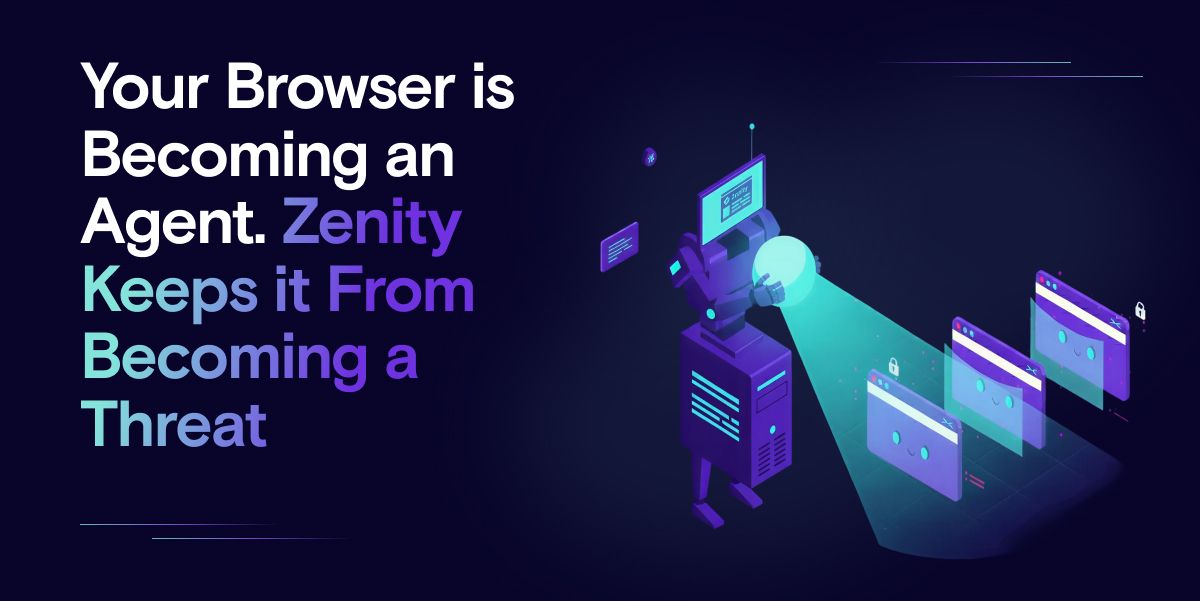
Agentic browsers are quickly becoming part of everyday work. Tools like ATLAS, Comet, and Dia can read web content, navigate SaaS tools, interpret instructions, and act on behalf of a user. They promise faster execution and higher productivity but they also introduce new risks that traditional security tools are not designed to see. As these browser-based agents spread across both managed and unmanaged devices, the enterprise attack surface grows in ways that most teams can’t quantify.
Zenity is expanding its coverage to include agentic browsers as part of our mission to secure what AI does everywhere. We want security teams to see what these tools can do, assess their real-world exposure, and enforce responsible guardrails before a mistake or compromise becomes an incident.
When Browsers Start Acting Like Agents
Agentic browsers collapse the distance between natural language, system-level actions, and access to sensitive enterprise data. According to the Zenity Agentic Browser Threat Model, these agents interpret intent in real time, read arbitrary web content, and take actions that appear identical to user activity
Zenity Labs observed that agentic browsers often hold deep access to local files, cloud sessions, internal tools, developer environments, and private portals. These agents can reach sensitive local data, cloud infrastructure, communication platforms, identity systems, and customer management tools. This level of access means that if an agentic browser is compromised, the impact can be immediate and severe.
Many of these tools are installed informally by employees. They often operate without visibility or governance, making them one of the fastest growing sources of shadow AI inside the enterprise.
The New Attack Surface Hiding in Plain Sight
Agentic browsers introduce risks that unfold quietly and quickly. A single webpage or interactive element can contain indirect prompt injection that causes an agent to perform unintended actions. An agent reading a local directory can extract environment variables or tokens that unlock deeper access. A tool interacting with Jira, GitHub, or Confluence can modify issues, edit code, or change permissions. When these actions propagate across connected systems, lateral movement can occur before monitoring tools detect anything unusual.
The browser becomes a privileged automation hub. The threat is not malware. The threat is ungoverned autonomy.
Zenity’s Move: Securing AI Wherever It Runs
Zenity provides coverage for agentic browsers through a unified set of detection, monitoring, and protection capabilities. This gives security teams a clear understanding of where these tools are running, what they can reach, and how they behave in real enterprise environments.
Discover Agentic Browsers Everywhere
Automatically identify ATLAS, Comet, Dia, MCPs, coding assistants, and other agentic tools across managed and unmanaged devices. This gives security teams visibility into the full range of agentic capabilities in the enterprise. It also enables teams to get ahead of their shadow AI challenges by uncovering tools that appear without approval or governance. With this unified inventory, organizations can understand their AI footprint and begin governing it with confidence.
Create Real-Time Guardrails
Security teams can build policies that flag or block risky or unauthorized actions. These controls help prevent high-risk interactions inside enterprise systems and reduce exposure to external or untrusted domains.
Detect and Prevent Data Leakage
Zenity monitors agentic browser behavior for signs of sensitive data exposure, unsafe tool use, or misuse of access. This includes classic in-chat data loss risks such as secrets, PII, PCI, PHI, customer information, and confidential enterprise data.
Integrate Seamlessly Into Existing Workflows
Agentic browser insights feed directly into existing SOC, IT, and governance workflows. Security teams can incorporate agent activity into their incident response processes without disrupting established tools or practices.
Real Security for Autonomous Browsing
Zenity’s approach is guided by ongoing research from Zenity Labs. This research includes extensive testing, threat modeling, and analysis of how agentic systems behave in real-world conditions. It builds on frameworks such as MITRE ATLAS and OWASP LLM security guidance and identifies key threat categories including indirect prompt injection, memory poisoning, identity risk, lateral movement, data disclosure, and destructive actions.
The Zenity endpoint agent supports this coverage through a lightweight and low-friction deployment model. It runs with least-privileged permissions and minimal performance impact, and it can be deployed silently through standard UEM tools. Organizations can begin in detect mode and gradually move to prevent mode. Prevent mode presents a clear message to users inside the agent chat so they understand the action without interrupting their workflow.
Explore the Research Behind This Release
For a deeper look at how agentic browsers expand the enterprise attack surface, download the Zenity Agentic Browser Threat Model. The report outlines real attack paths, risk categories, and findings from Zenity Labs. It is a valuable companion to these new platform capabilities and helps teams understand why agentic browser governance is becoming essential.
Get Started Before Your Browser Gets Ideas
Agentic browsers are reshaping how employees interact with enterprise systems. They extend what individuals can do, but they also introduce new opportunities for attackers and new ways for sensitive data to move beyond expected boundaries.
With expanded support in the Zenity platform, security teams can discover these tools, monitor their behavior, and govern them responsibly. Visibility and control are the first steps toward safe adoption.
To see agentic browser protection in action, book a live demo or connect with our team.
Related blog posts
Securing the AI That Runs the Enterprise: Zenity + ServiceNow SecOps
As agents take on more responsibility, they also introduce a new class of security challenges, ones that traditional...
The Shift to Continuous Context and the Rise of Guardian Agents
AI agent risk doesn’t emerge in a single moment. It develops over time across configuration changes, runtime behavior,...
OpenClaw Needs Real Security Controls; We Built Them Open Source
AI agent adoption and development are evolving quickly. The tooling used to build agents is improving fast, but...
Secure Your Agents
We’d love to chat with you about how your team can secure and govern AI Agents everywhere.
Get a Demo